The Original Version Myth: Why Retellings Are Not Copies
The original version myth treats retellings as copies. Learn how to read changes in voice, emphasis and audience as meaningful choices, not errors.
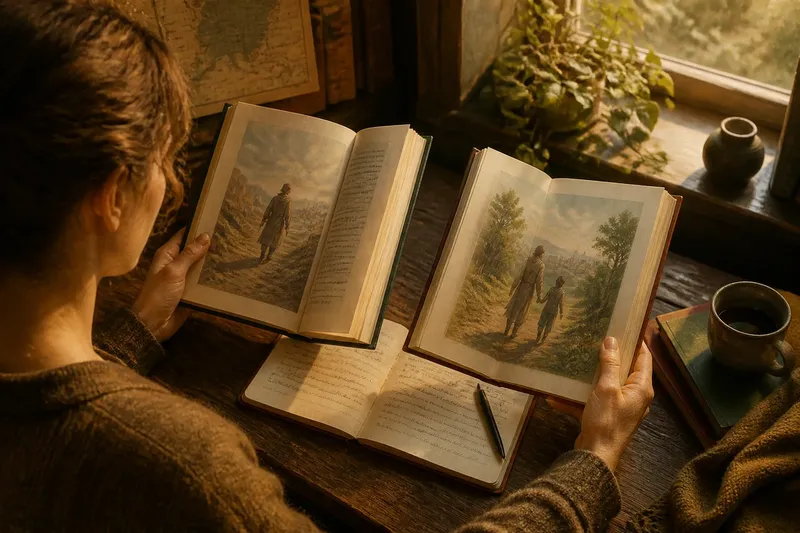
A reader opens two books about the same wandering hero and notices that one gives the hero a sister, while the other leaves family out. The original version myth makes the difference feel like a mistake: surely one book must be the faithful one. But stories that travel through languages, communities and generations rarely offer a single, untouched source against which every retelling can be measured.
That does not mean every change is equally apt, or that a retelling escapes criticism. It means asking what a version does, whose choices shaped it and what its audience is being asked to notice. These six reading habits help replace a hunt for the one true text with closer attention to the work in front of you.
1. Ask what “original” means
“Original” can refer to the earliest surviving written account, a source named by the reteller, the first version a reader encountered, or an imagined beginning before a story was told aloud. Those are different things. A printed text may be the earliest one a scholar can point to without being the first form the story ever took.
When a book claims to retell a particular source, that claim gives you something concrete to examine. Look for the source named in its preface or notes, then compare the stated relationship with what the reteller has made. If no source is identified, avoid treating a familiar school or film version as the standard by default. Familiarity tells you what you know; it does not settle where a story began.
This distinction also keeps criticism precise. You can say that a retelling departs from a named text in a particular way. Calling that departure a betrayal assumes, without argument, that closeness was the work’s main purpose.
2. Trace the version’s route
A story may pass through spoken performance, translation, adaptation and print before reaching a new reader. Each stage can leave signs: a change of setting, a different name, an episode that appears only in one branch, or a note explaining a source. These clues are not a complete map, but they help distinguish a direct retelling of a named text from a version shaped by several routes.
Read a translator’s note and the acknowledgements alongside the story, not as a verdict but as useful context. If a reteller says they worked from a translation, they may have inherited decisions made earlier about names, tone or cultural references. If they draw on several versions, the book may deliberately bring together strands that a single-source comparison would miss.
Keep uncertainty visible. A version’s route may be partly undocumented, and a confident claim of direct descent can oversimplify a tangled history. Describe the connection the available information supports rather than filling gaps with a neat family tree.
3. Notice the chosen viewpoint
Retellings often shift attention to a figure who was previously a helper, opponent or passing presence. That shift changes more than the amount of page space. It can make an old decision look different by giving its consequences a witness, or show how the central character’s account leaves someone else out.
Track who narrates, whose thoughts remain unavailable and which events receive the most attention. A narrator may be unreliable, limited or openly argumentative. Those choices shape what you are invited to believe, but they do not automatically make the new account truer than an earlier one. A retelling can challenge a silence without claiming to erase every problem in the source.
Imagine a writer gives the former gatekeeper a speaking role and lets that character describe the same departure as a loss rather than a triumph. The expected result is not a corrected record; it is a reader who can recognise how viewpoint changes the meaning assigned to one shared event.
4. Read omissions as decisions
Every retelling leaves something out. A scene may disappear because the book is shorter, because its audience has different background knowledge, or because the writer wants another conflict to carry the story. An omission can also be ethically or artistically deliberate. It is worth asking what the new version makes possible, and what it makes harder to see.
Choose one absent scene you remember from another telling. Note what information it supplied: a motive, a warning, a relationship or a reason for an ending. Then ask whether the new version supplies that information elsewhere, asks you to infer it, or leaves the gap open. These are distinct effects. Calling all of them simplification misses the craft choice involved.
Absence alone does not prove that a writer has censored, misunderstood or improved a story. To make that case, point to the particular change and its consequences within the version you are reading. That keeps a judgement connected to evidence on the page.
5. Compare aims, not scores
Two retellings can make different promises. One may preserve a sequence of events closely; another may relocate the action, change the narrator or address readers who have never met the source. A single faithfulness score collapses those aims into one scale and makes difference look like failure.
Instead, compare a defined feature. Ask whether both versions keep the same central conflict, how they treat the ending, or which character receives sympathy. Then consider whether each choice fits the reteller’s stated purpose and the experience created by the text. You may still prefer one version, but you can explain what your preference rests on.
Say you are comparing a close retelling with a contemporary reworking. If the first preserves the plot but alters the tone, while the second changes the setting but holds on to the central dilemma, describing both through one fidelity score hides what each actually preserves. A feature-by-feature comparison gives you a clearer basis for discussion.
6. Consider the intended audience
A retelling is made for readers, listeners or viewers in a particular setting. Their language, shared references and expectations can influence what is explained, renamed or left implicit. A version written for children, for instance, may handle frightening material differently from one aimed at adults; neither audience label tells you the quality of the result.
Notice where the text pauses to explain a custom, assumes you recognise a reference, or offers a note that opens a door beyond the story. Ask what kind of knowledge the version expects and whose perspective it treats as familiar. This can show how the retelling positions its audience without assuming that every unfamiliar element has been translated away.
Audience is not an excuse that ends the discussion. You can still ask whether an explanation clarifies, flattens or redirects attention. The useful question is what that choice does for these readers in this version, rather than whether it matches an abstract ideal of accessibility.
What should readers ask?
Is there always one original version?
No. Some stories have a named written source, while others circulated in multiple forms before a surviving text was recorded. Treat “original” as a claim to clarify, not a fact to assume.
How can I compare two retellings fairly?
Choose a specific feature, such as viewpoint, sequence or ending, and examine what each version does with it. This supports a reasoned preference without reducing the comparison to a single score.
Does a major change make a retelling less faithful?
It may make the retelling less close to one named source, but closeness is only one possible aim. Ask what the change alters and whether that alteration serves the version’s approach.
Where can I learn what source a book uses?
Check the preface, translator’s note, endnotes and acknowledgements for named texts or accounts of the writer’s process. If the route is not stated, keep your account of the connection tentative.
Make the comparison exact
The original version myth loses its hold when “faithful” stops standing in for “good”. Read the retelling’s own claims, identify the feature that changed and name the effect you can observe. When you discuss retellings, that exactness lets you value invention without pretending that sources do not matter.
A useful final question is not simply whether this version matches the one you already know. Ask what it asks you to see, and what its choices leave available for another telling.