A First Reading Across Cultures: Pause Before You Fill the Gaps
A first reading across cultures can help you notice unfamiliar references, separate a text from your assumptions and keep open questions open.
You reach a family gathering in a novel, meet three relatives by a name you do not recognise, and realise you have started guessing who outranks whom. A first reading across cultures works better when you pause at that moment: record what the page gives you, mark what you are supplying, and let some questions wait.
This is a routine for one book, poem or story, spread across a week of ordinary reading. It is not a demand to decode every reference before you continue. The aim is to notice where your own habits are filling gaps, without turning uncertainty into a verdict about the text or its culture.
Before opening the text
Choose a reading space where you can make brief notes: a paper notebook, the Notes app or a pencil in the book’s margin. Keep a bookmark or sticky tabs handy if writing on the page is not an option. Set aside a little time on several days rather than trying to investigate every unfamiliar detail in one sitting.
At the top of your notes, write the title, the edition or translation you are reading, and the date you began. This gives you a simple record of which wording you encountered. Avoid seeking a cultural primer before you read the opening pages; early explanations can make later details feel settled before the text has shown what they mean.
Use three marks as you read:
- T for something the text directly tells you.
- I for an inference you are making.
- ? for a question you cannot yet answer.
These marks are not grades. An inference may be sensible and still remain an inference. If you cannot decide whether a detail belongs under T or I, mark it with a question mark and move on.
During the first sitting
Read a manageable stretch without stopping for every unfamiliar word, custom, place or form of address. When something catches your attention, make a short note rather than opening a search tab. Note the page and the detail itself: “two cups set aside” is more useful than “ritual?” because it preserves what you actually saw.
Keep the note free of an explanation at first. If the narrator says a character bows before speaking, record that action. Do not immediately label it as respect, fear, politeness or submission unless the passage says so. Those interpretations may matter later, but the first task is to distinguish the visible detail from the story you are building around it.
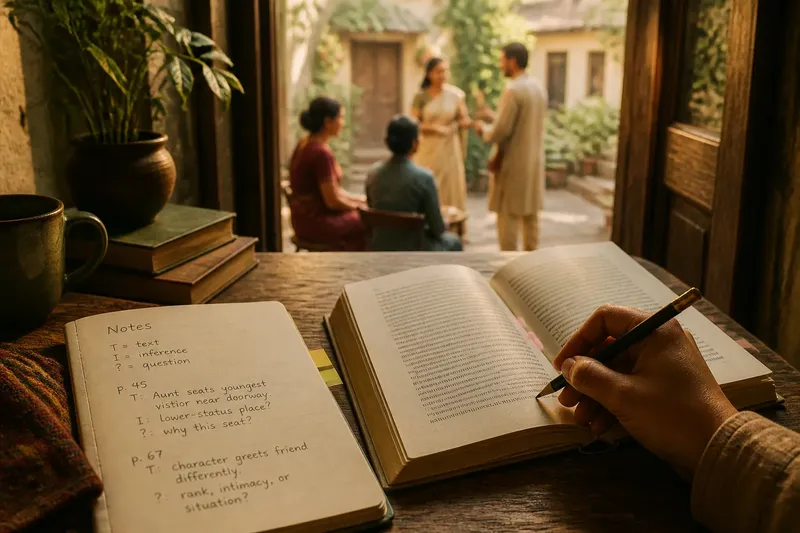
Say you are reading a scene where an aunt gives the youngest visitor a seat near the doorway. You write, “T: visitor is seated by doorway; I: this is a lower-status place; ?: why this seat?” That note leaves room for the next scene to change your reading. It does not assume the seating means the same thing in every household or setting.
After each sitting
Take a few minutes to sort your marks before you put the book away. For each question, ask whether it concerns the wording, the plot, or a context outside the text. A question about who has entered the room may be answered in the next pages. A question about a ceremony may need context the story has not supplied.
Keep a short “still open” list. Add the page, the detail and the exact question, without drafting a likely answer beside it. If the same reference appears again, add the new page rather than replacing your first note. Recurrence can show that a detail matters to the story, but it does not by itself tell you what it means.
When you want to look something up, first finish the scene or chapter you are in. Then choose a source that matches the question. A translator’s note or a publisher’s glossary can clarify a term used in that edition; a reliable cultural or language reference may help with a wider question. Separate anything you learn from what the narrative explicitly states, and note the source so you can return to it.
When to look things up?
Should I search every unfamiliar word?
No. Mark words that affect your understanding of an action, relationship or repeated image, and keep reading when the scene remains clear without them. A quick dictionary check can clarify a translated word, but it may not explain why that word matters in this passage.
What if I miss a cultural reference?
Leave a question mark and continue if the plot still makes sense. If the reference returns or changes what a character does, bring it to your notes after the scene rather than guessing from a single appearance.
Can I use the translator’s note?
Yes, especially when it addresses a term, wordplay or choice in the edition you are reading. Treat it as a useful explanation with a particular scope, not as a replacement for the passage’s own clues.
Should I ask someone from that culture?
You can ask a willing, knowledgeable reader about a specific question, while recognising that one person cannot speak for an entire culture. Share the exact passage and explain what the text says separately from what you inferred.
At the end of the week
Return to your open list after you have read a substantial portion, or reached a natural pause if the work is short. Sort questions into three groups: answered by the text, clarified by a source, and still unresolved. Keep the last group; an unanswered question is not a reading failure.
Now revisit your T and I marks. Where the text has supplied new information, add it beside the earlier note rather than quietly rewriting your first impression. If a character’s action looked like deference at first but later appears strategic, record that shift. It shows how the story changed your reading, not that your earlier uncertainty was a mistake.
Say your notes concern a greeting that seemed unusually formal. Later, the narrator describes the same character greeting a close friend differently. You can now record the contrast as a detail in the text, while leaving open whether it reflects rank, intimacy, the situation, or more than one thing. The distinction keeps a useful observation from turning into an overconfident cultural rule.
Keep the questions open
Before putting the book away for good, choose one unresolved question that still affects your understanding. Write it as a question about this particular passage, not a claim about a whole people or tradition. Then decide whether a note in the edition, a trustworthy reference or a later rereading could help; if not, let it remain open.
A first reading across cultures is most useful when it makes your attention more precise, not when it produces a complete explanation. Keep the notes that distinguish the page from your assumptions. They will help you return to the story with curiosity intact and a clearer sense of what you know, what you suspect and what the text has chosen not to settle.