The Frame Around a Story: Why Form Changes What We Notice
See how a story’s frame changes what readers notice, using one invented tale told as a letter, fragments and continuous narrative.
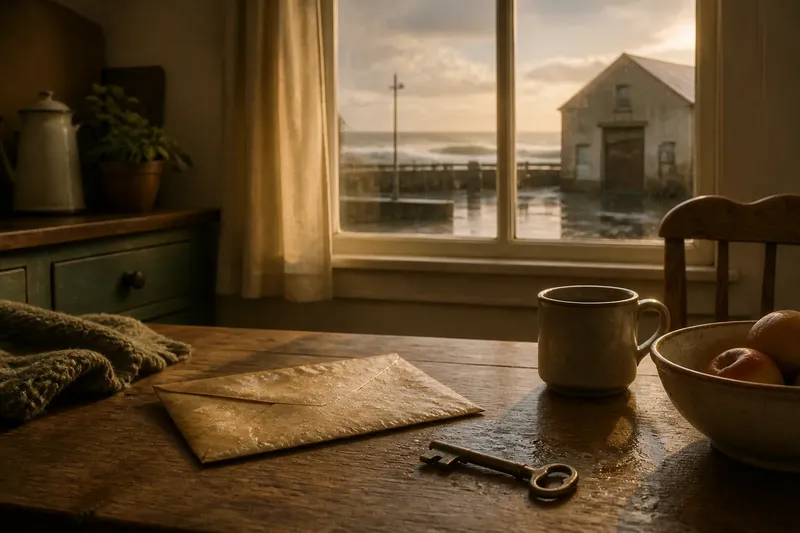
At a kitchen table, a damp envelope lies beside a key that does not fit the front door. The first line of a story can put that envelope in a reader’s hand—or leave it unopened until much later. The frame around a story, including its form and order, changes what readers notice before they know what the events mean.
Consider one invented situation: Mara returns to her coastal hometown after her brother Leo disappears during a storm. On the kitchen table she finds his envelope, addressed to her, and a brass key. The letter inside mentions a locked room in the old ferry station. Mara goes there, discovers the room empty, and later learns Leo had left town to avoid a family dispute. The central events stay fixed. What changes is how the telling directs attention: towards a speaker, a sequence of clues, or the unfolding encounter itself.
This is a useful way to think about story form. Form does not merely package events. It decides what reaches the reader first, what remains outside the frame, and which details acquire weight. A letter can make the story feel like an intimate message. Fragments can turn it into a search. Continuous narration can keep the reader close to Mara’s changing understanding.
The letter’s narrow window
In a letter version, Mara tells the story directly to Leo. She describes finding the envelope, opening the locked room and hearing from their aunt that he has left. The address on the page makes Leo feel present, even though he is absent from the events. Each sentence carries two audiences: the reader and the person Mara hopes will receive it.
That address changes what counts as important. Mara might explain why she did not answer his last message, or mention the family habit of leaving keys in flowerpots. Those details could seem incidental in a broad account, but they acquire force in a letter because they belong to a relationship. A reader is likely to ask not only “What happened?” but also “Why is she telling him this?”
The letter also has a built-in boundary. It can report what Mara knows, remembers or chooses to disclose; it cannot enter Leo’s mind unless he has told her what he thought. This limitation can make a story feel close and partial at once. The reader hears an intimate voice while noticing the absences around it.
For a writer, that means the recipient must matter beyond the salutation. If Mara writes to a brother she has not spoken to, she may soften blame, withhold a family secret or write as if he could still reply. Each choice shapes the story’s emotional frame. A letter that simply retells events without pressure from its addressee may read like ordinary narration with a greeting attached.
Readers can use the same question in translation or across cultures: who is being addressed, and what does that relationship allow the speaker to say? A form built around direct address may carry a different sense of intimacy when translated into a language with distinct conventions for politeness, kinship or formality. The events remain recognisable, but the social distance of the voice may shift.
Fragments as a trail
Now imagine the same story arranged as fragments: a note from Leo, Mara’s list of objects from the kitchen, a ferry timetable, a paragraph from the aunt, and a final message sent after Mara visits the station. The fragments do not have to explain themselves at once. Their order encourages the reader to assemble a version of events.
In this form, the brass key may appear before the reader knows what it opens. The ferry timetable may sit beside a message that seems unrelated until the aunt mentions the locked room. Such placement creates expectation. The reader starts comparing sources and asking which account is incomplete, mistaken or deliberately guarded.
Fragmentary form directs attention to gaps as much as to statements. A missing date, an unexplained name or a sudden change in handwriting can become a clue because the reader expects the pieces to connect. But ambiguity needs boundaries. If every fragment introduces a new person or mystery, the reader may have no basis for deciding what deserves attention.
To keep the trail legible, give each piece a distinct job. Leo’s note can establish what he wanted Mara to find. The list can show which objects she noticed and which she ignored. The aunt’s account can challenge Mara’s assumptions. A later message can revise the meaning of an earlier detail. These pieces need not agree, but their differences should matter to the story.
Order is especially visible here. Put the aunt’s account before Mara reaches the station, and the visit may feel like a test of what she has heard. Place it after, and it may recast the visit as a mistaken pursuit. The sequence does not change the events; it changes the reader’s working explanation of them.
Continuous narrative in motion
A continuous version could begin as Mara opens the envelope and follow her through the walk to the ferry station. The reader encounters the key, the storm damage and the aunt’s explanation in the order Mara does. Instead of reconstructing a packet of evidence, the reader moves through a present-tense chain of attention, even if the prose uses past tense.
This form can make small observations accumulate. Mara might first notice that the key is cold from the rain, then that its teeth do not match the station lock, then that the door stands ajar. Each detail adjusts her immediate expectation. The reader is not just told that she is anxious; the sequence gives that anxiety a route through what she sees.
Continuous narration is not automatically more complete or objective. It still selects a viewpoint, skips moments and decides how much context to provide. A close third-person account may stay with Mara while she misreads Leo’s note. A more distant narrator may reveal the aunt’s explanation earlier. Either way, the chosen distance affects how much the reader knows alongside the character.
When adapting this form, attend to transitions. A jump from the kitchen to the ferry station needs enough orientation for the reader to understand what Mara carries with her and why she goes. Too much explanation can flatten the movement; too little can make a meaningful action seem arbitrary. The aim is not to report every step, but to preserve the links that shape motive and consequence.
What does each form foreground?
What does a letter make the reader notice?
A letter foregrounds the bond between writer and recipient, along with what the writer chooses to confess, explain or evade. It suits a story in which the act of telling is part of the relationship, not merely a container for events.
Why use fragments for a story?
Fragments suit a tale built around incomplete evidence, conflicting memories or delayed connections. Their order can invite readers to make and revise interpretations, provided each piece contributes a recognisable part of the whole.
When does continuous narration work best?
Continuous narration is useful when the character’s changing attention matters as much as the final explanation. It lets readers experience discoveries in sequence, while still allowing the narrator to control viewpoint and pace.
Can the same story support all three forms?
Yes, if each version has a reason to exist. The letter can centre on a difficult address, the fragments on disputed evidence, and continuous narration on Mara’s immediate decisions; using all three simply to repeat the plot would add form without adding meaning.
Choose the frame deliberately
Say you are drafting a short story about someone finding an old key. Before writing the full version, imagine three openings: a message addressed to the key’s former owner, a dated scrap that records where it was found, and a continuous scene of the character trying it in a door. The message will raise questions about the relationship. The scrap will invite a reader to connect clues. The scene will make the physical attempt and its result the immediate focus. Choose the opening whose questions belong to the story you want to tell.
Then make a simple form map. Write down what the reader knows at the start, what is withheld, and what changes their understanding. For a letter, include the recipient and the speaker’s reason for writing. For fragments, list each piece and the inference it permits. For continuous narration, mark the viewpoint and the moments when new information arrives. This small plan can expose a mismatch early: perhaps a supposed mystery is explained before the reader has anything to wonder about, or a letter has no meaningful recipient.
Read the draft once for information order, not sentence polish. At each turn, ask what the reader is likely to expect now. If a detail matters later, check whether its first appearance gives it enough presence to be remembered. If a withheld fact matters, check that the form creates curiosity rather than confusion. These are editorial questions, not rules; a story may deliberately frustrate expectation, but the effect should come from a chosen frame.
For a translated story, a retelling or a text that travels between audiences, form can be part of the meaning that moves with the events. A letter’s social address, a fragment’s silence and a continuous scene’s closeness may not carry over in exactly the same way. Notice what the form asks readers to do, then decide which invitation must remain and which can change.
The frame is doing its work whenever a reader’s attention lands somewhere before the explanation arrives. For Mara, that might be Leo’s name on the envelope, the key without a lock, or the rain following her to the station. Choosing the form means choosing which of those details gets to lead—and what the reader can see from there.